
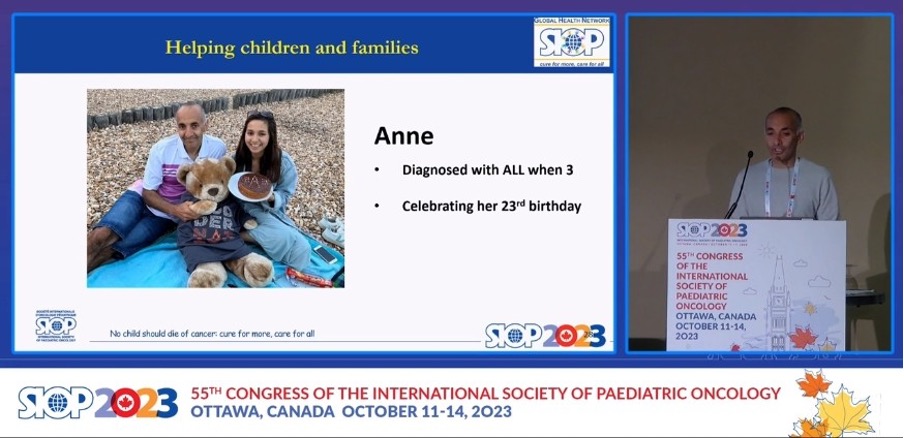
The last slide of my presentation – thanking everyone that provides online training – enabling children with cancer to grow up and have birthdays
I would like to share three things with you today:
- My account of the International Society of Paediatric Oncology – SIOPannual congress in Ottawa
- Some thoughts on how I should think differently
- Something that really inspires me
What did I get out of attending the SIOP Congress in Ottawa?
The vast majority of the people I work with regarding paediatric oncology I only see once a year at the annual congress. I attended many productive meetings, a couple of heated ones, and plenty of inspiring and interesting presentations on paediatric oncology as it relates to global health. Seeing people get rewarded for their work, and in many cases decades of work, is truly inspiring.
It is a privilege and pleasure to see presentations on projects I am involved with that either have the power to save lives and enable collaboration (SIOP Global Mapping), and projects that are literally saving lives.
I attended the conference in multiple capacities:
- Education and Training Committee Member
- Global Health Network member
- Member of the SIOP Global Mapping team
- Global Health Network Core Steering Group member
- Member of the CANCaRe Africa advocacy team
- Unofficial advocate for the Fun(d) Run (this raised £4,400 for a local charity)
- A parent of a survivor of childhood cancer
I would like to share some thoughts about some of the projects that I am particularly passionate about.
Every facility treating children with cancer in the whole wide world
I have been involved in this since 2018. We are creating a database of all facilities treating children with cancer across the world. Yes that’s right, every facility in every country. This is to help parents, provide data for national societies to advocate for more resources, and enable collaboration. We recently reached a big milestone with Latin America and Africa mapped This is Maite Gorostegui, a paediatric oncologist from Barcelona, and chair (and President) of the SIOP Global Mapping Team giving an update and showing this wonderful map that will shortly be published.
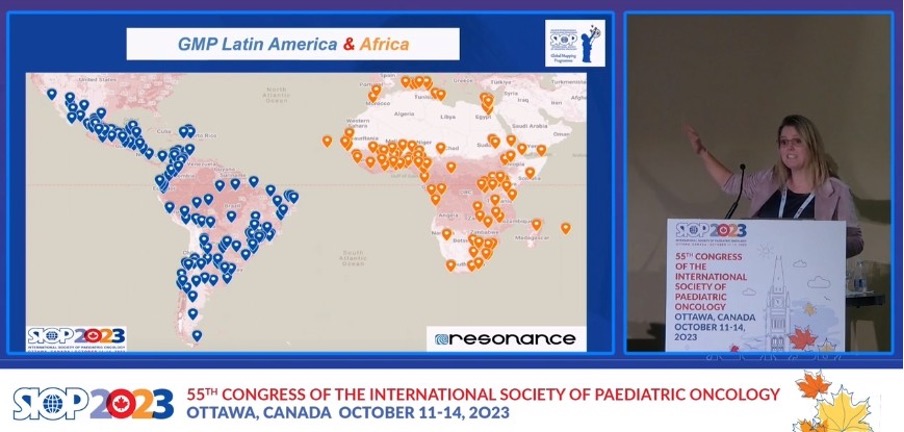
Dr Maite Gorostegui presenting at Ottawa
You can read more about the SIOP Global Mapping programme here: https://siop-online.org/news/blog-we-are-just-about-to-start-mapping-asia/
A new word – Abandonment
Not so long ago I came across the word “abandonment”. I didn’t know what it meant. This is the term for when treatment for cancer is not completed.
It is a huge problem and is the main cause (approximately 40%) of treatment failure in low income countries. This happens for a variety of reasons including families living in difficult conditions, families not having their basic needs covered, parents can´t afford to get to the hospital or the extra costs associated with caring for a child with cancer. What CANCaRe Africa – Zero Abandonment from Start to Finish does is provide small amounts of money to families with cancer. This can be for food when one parent is staying at hospital, or travel costs. This is carefully documented, and the data is showing it is working: families are finishing treatment. CANCaRe Africa is a project that is in action in 10 centres in 7 countries across Africa. Over the years I have been involved with many projects and groups. This one is close to my heart as I can see the data, and I can see rates of abandonment reducing, meaning lives are being saved.
Virtual training
We know that a lot of clinicians around the world treating children with cancer don’t have the necessary or best training. They are doing the best for children with very limited resources. They can’t afford to attend conferences or in-person training courses. We identified some of the key organisations and partners of SIOP that produce online training. This is me presenting the data at SIOP and listing some (definitely not all) of the organisations. See the end of this article for links to the organisations mentioned in the presentation. When we were discussing what to present, I didn’t think this was a very good idea. In fact, I was adamant it was a bad idea. I was completely wrong. The session was successful and well attended, and we had a very interesting discussion afterwards. Thank you Muhammad Saghir Khan for having the vision to push this forward.
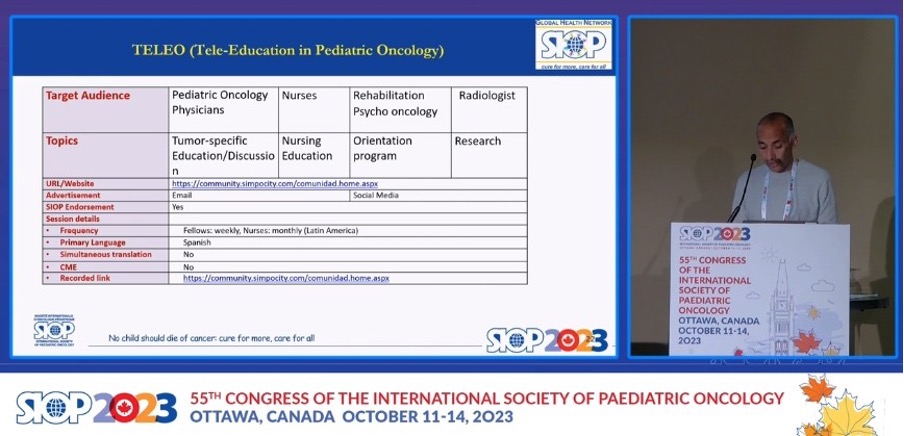
TELEO leading the way in providing online educational materials
Too Many Nos
One afternoon whilst in Ottawa we came across a problem. I couldn’t see a way around it. I was with Dr Matie Gorostegui who was coming up with a lot of ideas and suggestions. I was finding fault with all of them. She looked at me and said flatly, “Too many nos.” At first I was taken aback. Now, after much consideration, I realise that I need to be more aware of my behaviour. I often have ideas and suggestions, and I hope that others are receptive to them. Do I do the same for others? I am not saying that I must say yes to everything, but I do need to be more open to ideas and change.
Genuine inspiration
I am not a clinician. I am employed by the LSEG (London Stock Exchange Group) to help its clients buy and sell foreign exchange. In fact, it is interesting using my experience from being employed at a large multi-national to suggest things to the SIOP secretariat. That having been said, in my day job I am not involved in research, I am not treating children with cancer, or looking after their families. The majority of the paediatric oncologists and oncology nurses I meet are doing research as well as their day job. Often in their spare time, participating in or running meetings in the evenings and weekends, and attending conferences away from their families. These people don’t just work from 9am to 5pm. Especially when you consider where this research is being done, often by clinicians with an extraordinary workload, with staff shortages, poor supply of chemotherapy, power cuts etc. The research may or may not help their career, but it is definitely helping children with cancer. Thank you to all of you. And thank you for inspiring me and so many others with your dedication.
Breaking down barriers
SIOP comprises clinicians, researchers and a few parents. The last congress had 3,300+ healthcare professionals attending from 110 countries. They say that sport can be used to break down barriers. That may be true, but the medical community is a much better example. I have seen first-hand many collaborations between the global north and global south, research projects and clinical trials spanning continents including conflict zones, research teams with people from different continents. I haven’t done anything with Medicin sans Frontiers personally, but I have a lot of respect for what they do. Their ethos and name applies to the paediatric oncology community.
Decisions, decisions
I can’t write an account of Ottawa without mentioning my pink Adidas. This was the second decision of the day. Which trainers do I wear? Not an easy one is it? I had already made the first and another important decision, where do I run?
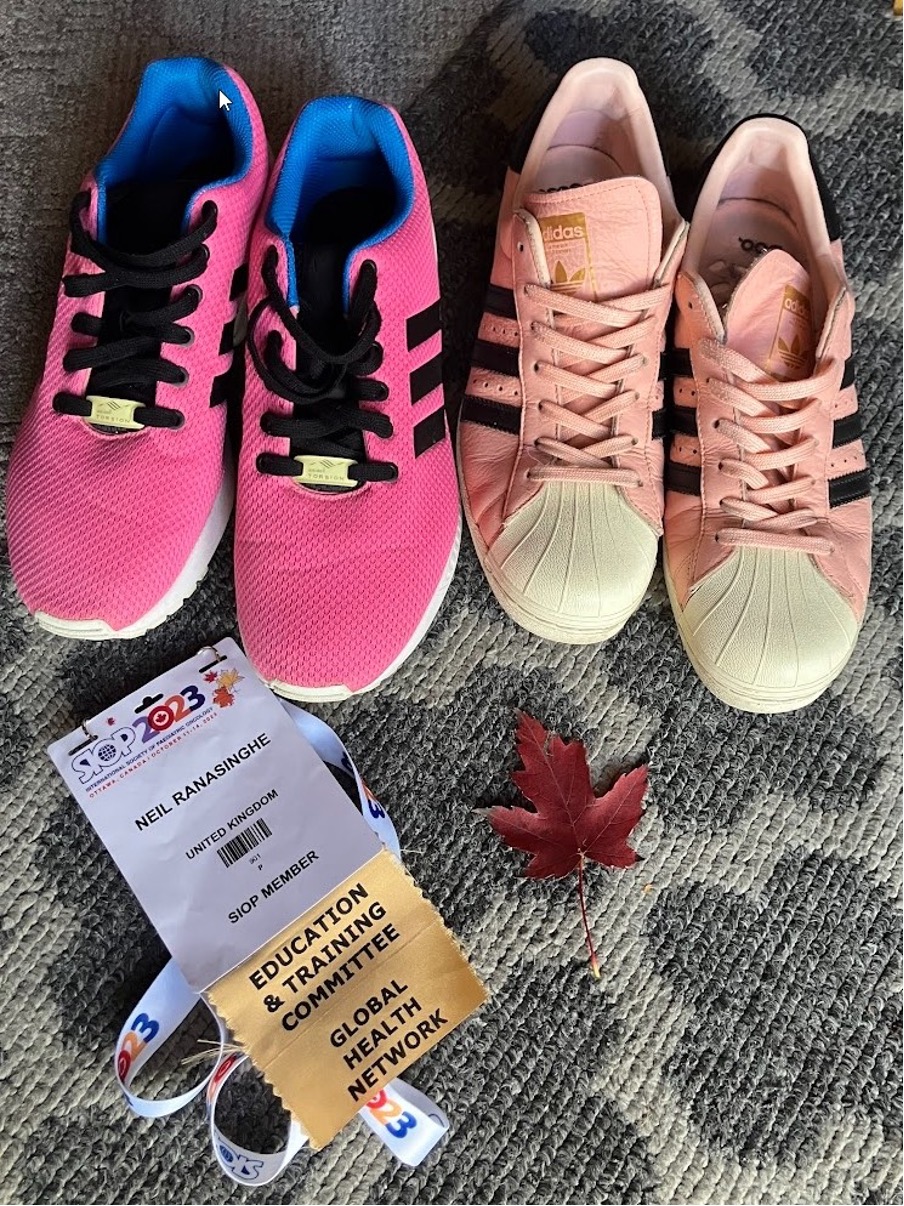
Pink or pink? Pink for breast cancer awareness month, and see the real red maple leaf.
It is because I am a Canadian ♫
Finally a massive thank you to the people of Ottawa. Without exception, everyone I interacted with was either friendly and helpful or very friendly and very helpful. I chatted to an officer of the Parliamentary Protective Service and asked for a selfie, and he put the flashing lights on for me.
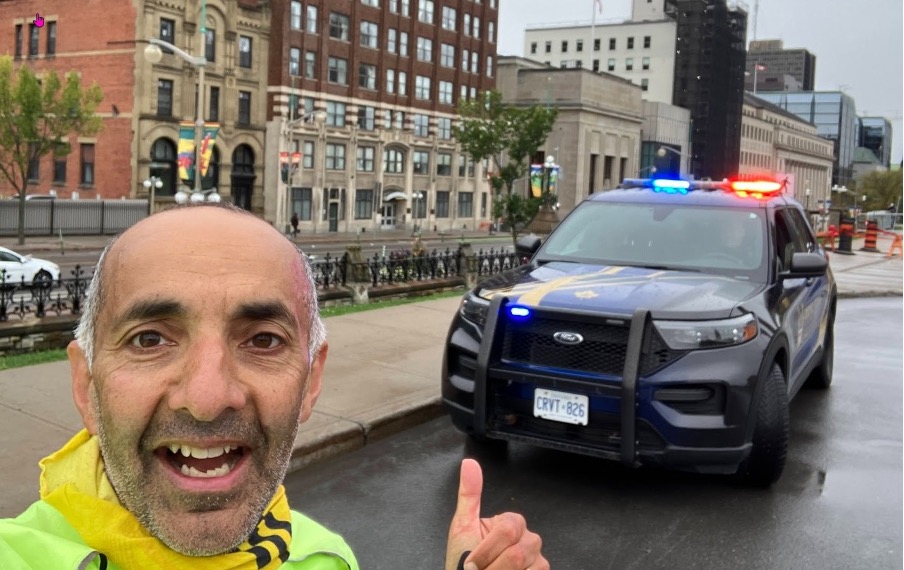
Stopped for speeding whilst out running…
I commented to a woman at the cloakroom in the Centre Shaw Centre that it was great seeing them all as they were always so cheerful, and she sang her reply to me. “It is because I am Canadian”.
Of course I had to try the local food, and in particular beavertails, a delicious cross between doughnut and pizza.
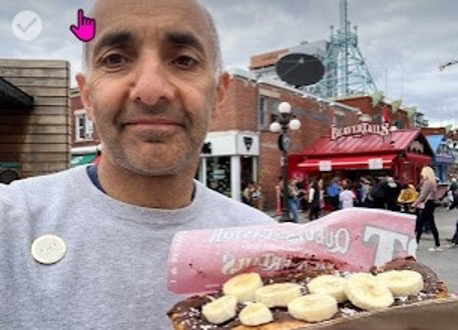
Definitely not a real beaver’s tail
Please get in touch
If you want to know more about any of the projects I have mentioned, or you have any suggestions or comments, please don’t hesitate to contact me. Neil.Ranasinghe@lseg.com. I need to sign off here as I have a very long list of actions from attending SIOP.
Organisations providing paediatric oncology online virtual training
| Organisation | URL |
| Groupe Franco Africain d’Oncologie Pédiatrique (GFAOP) | www.e-gfaop.org |
| Abbot Nutrition Health Institute | https://anhi.org/uk |
| St Jude | www.stjude.org |
| Paediatric Oncology East and Mediterranean (POEM) | http://poemgroup.org/ |
| Dorcas Cancer Foundation | https://tdcf.ng/pedroc/ |
| Tele-Education in Paediatric Oncology (TELEO) | https://community.simpocity.com/comunidad.home.aspx |
| Istanbul University Oncology Institute | https://doktorclub.com/ioue |
| International Paediatric Oncology Guidelines Network (IPOG) | https://ipognetwork.org/ |
| Cancer Institute, adyar Chennai | https://cancerinstitutewia.in/ |
| SIOP CEDAR | https://siop-online.org/cedar/ |
| SIOP Women Leaders Network | https://siop-online.org/women-leaders/ |
| Paediatric Radiation Oncology Society (PROS LMIC) | https://intpros.org/ |
| GHN T&CM Journal Club | www.siop-online.org |
| SIOP Nutrition Network | https://cancerpointe.com/nutrition/ |
| Young SIOP | https://siop-online.org/young-siop/ |
| SIOP Nursing Network | https://siop-online.org/ |
| SIOP Europe (SIOPE) | https://siope.eu/activities/education |
Thank you to Julie Waxgiser , Maite Gorostegui and Anne Ranasinghe for reviewing this article.

0 Comments