Nearly three out of four deaths worldwide are caused by four noncommunicable diseases (NCDs): cardiovascular disease, cancer, chronic respiratory disease, and diabetes.1 The Political Declaration on the Prevention and Control of NCDs and the Promotion of Mental Health and Wellbeing that will be adopted at the 4thHigh-Level meeting (HLM4) during the UN General Assembly in New York on 25 September 2 provides every country with the opportunity to strengthen its commitment to reaching the Sustainable Development Goal agreed in 2015 3 of reducing premature deaths from NCDs by a third by 2030.
Whether governments care sufficiently for the welfare of their populations to seize the opportunity remains to be seen. The evidence that political leaderships are prepared to prioritise addressing the critical gaps in NCD prevention and mental health care that require urgent action, or even publicly acknowledge the scale and the urgency of the global NCD pandemic, is not strong. As a recent report in The Lancet states ‘NCDs are inherently political because effective interventions touch upon trade, industry, and regulation amid concerns about countries’ sovereignty.’4
Industry pressures to water down regulations on sugar and salt content and on tobacco excise in the final draft of the Political Declaration are rumoured to be proving effective. The situation is not helped by the fact that HLM4 is being hosted by an organisation showing its age (the United Nations is 80 this year) and that the meeting is taking place against a background of mounting international tension and in a country whose administration has officially rejected and denounced the UN’s Sustainable Development Goals,5 defunded the World Health Organization 6 and closed down USAID, 7 reneging on its previous promises to provide aid to vulnerable populations.
Although many people would like to think so, America is not an exception. The Millennial promise of making a better world proved short lived. Corporate philanthropy, already reduced by global financial crises, has been further impacted by the unilateral and chaotic on-off imposition of tariffs. Across the high income donor countries government money previously spent on Development Aid is now being allocated to Defence 8,9; the financial equivalent of turning ploughshares into swords and pruning hooks into spears. The message is clear: ‘The lamps of overseas development aid are growing dim all over Europe and we shall not see them shine brightly again in our lifetime.’
Fortunately, the global cancer community either has not received the memo or is choosing deliberately to ignore it. UKIGCN members Aileen Flavin and Kirsten Hopkins, supported by funding from Climbers Against Cancer, continue to work with partners in Nepal and Pakistan providing Nepalese clinical oncologists with training on paediatric radiotherapy 10. Last month, with UKIGCN support Annie Young and Susie Stanway or delivered a three day educational breast and cervical cancer awareness raising programme to women in Somaliland. This month, thanks to the determination and hard work of Katie Wakeham and her colleagues on the WRAD committee we have seen the launch of the first World Radiotherapy Day on 7 September11 celebrating the date in 1953 when the first patient was treated on a linear accelerator at the MRC Radiotherapeutic Research Unit, Hammersmith Hospital, London. Elsewhere, transnational collaborations continue to be encouraged. World Cancer Research Fund International has published its latest Calls for its Regular Grant Programme and its Inspire Research Challenge 12 both of which are open to international applicants. The Scottish government is funding a £3million initiative delivered in partnership with Global Health Partnerships (formerly THET) that will strengthen health systems in Malawi, Rwanda, Zambia, and Scotland, by supporting networks of frontline health workers who share skills, experience, and knowledge across borders.13 Health Information for All (HIFA) is in discussions with WHO concerning a major push next year to address the growing threat of online misinformation and disinformation related to cancer prevention and care in vulnerable populations.
These are extraordinary times that call for extraordinary commitment. The UK and Ireland Global Cancer Network stands shoulder to shoulder alongside fellow partners in the global cancer community as we continue to move forward, heads bent against increasingly strong fiscal headwinds, towards the goal of universal and equitable cancer care and prevention. Global cancer’s ‘super power’ lies in its international partnerships, and in the fact that its enduring sense of obligation to Humanity is not term-limited but persists long after obstructive administrations lose office and financial storms abate.
Tickets are now available for the London Global Cancer Week Final day event “Cancer Health Disparities: Understanding the inequalities conundrum” on Friday 15th November 2024. The venue will be the House of Commons Terrace Pavilion.
Cancer disparities continue to disproportionately affect underserved and marginalized populations, leading to higher mortality rates, reduced access to care, and poorer outcomes. This event’s programme will serve as a platform to discuss these disparities, share knowledge, and develop actionable strategies to reduce inequities in cancer care.
The event will include keynote presentations, panel discussions, interactive workshops, and community engagement sessions. It will highlight current research on cancer disparities, success stories from communities that have implemented effective interventions, and opportunities for stakeholders to collaborate on future initiatives.
The event starts at 9a.m. (but get there early because of the security checks) and the speakers include:
Dr. Olubukola Ayodele
HE Dr. Zainab Shinkafi-Bagudu: President Elect UICC, Founder, Medicaid Cancer Foundation
Dr. Jessica Bate (Great Ormond Street) on Friday, 15 November 2024
Prof. Jean-Marc Bourque: Chair, Canadian Global Oncology Group
Ms. Dawn Butler MP, House of Commons
Prof. Charlotte Coles
Prof. David Collingridge, Vice President Lancet, Editor-in-Chief, Lancet Oncology
Prof. Laurence Court (MD Anderson Cancer Center)Baroness Ilora Finlay of Llandaff MP, House of Lords
Ms. Emma Foreman
Prof. Ophira Ginsburg, National Cancer Institute-Centre for Global Health
Dr. Chineye Iwuji
Prof. Nick James
Dr. Nwamaka Lasebikan (NICRAT, Nigeria)
Dr. Tanimola Martins (University of Exeter)
Keith Morgan, Associate Director of Black Health Equity, PCUK
Prof. Nirmala Bhoo Pathy
Dr. Warren Phipps (University of Washington)
Prof. Pat Price
Dr. Siva Tharshini Ramalingam
Mr. Neil Ranasinghe
Dilnasheen Safdar (Director of Nursing and Infection Control, National Institute of Blood Diseases, Lahore Campus, Pakistan)
Prof. Kathleen Schmeler: Vice President of Global Oncology, MD Anderson
Daniel Sherman (Lacks Cancer Center, Grand Rapids, Michigan)
Mr. Ben Simms: CEO of Tropical Health Education Trust
Prof. Richard Sullivan
Prof. Gevorg Tamamyan
Dr. Dario Trapani
Dr. Irene Weru (Honorary Lecturer, Department of Pharmacy, University of Nairobi, Kenya)
Rob Yates (London School of Economics)
Prof. Annie Young
Space is limited to 100 people, and it is first come first served. Register for this stellar event and purchase your ticket here:
The UKIGCN has undergone an overdue spring clean courtesy of Simon Middleton. The function of our website is primarily to be the Network’s presence on the internet and to provide a ‘shop window’ by which visitors can find out about the Network and how it fulfils its triple function of serving as a national liaison point, raising awareness within the UK and Ireland about the impact of cancer on poorer resourced countries and acting as a catalyst for projects run by its Active Members in collaboration with colleagues in LMICs.
Survey published
The results of the first UK-wide survey conducted by UKIGCN have been published. Titled UK Cancer Healthcare Professionals collaborating with Colleagues in low- and middle-Income Countries: Mapping the Extent and Nature of Partnerships; Future Implications, the paper appears in the October edition of Clinical Oncology DOI: 10.1016/j.clon.2024.05.015) Congratulations and our profound thanks go to Katie Wakeham and all her co-authors for their hard work. This has been a mammoth task, providing invaluable lessons for when the Network repeats the survey next year.
UKIGCN Action Groups
The Network now has 2 Action Groups with projects at different stages of development.
Improving the quality of paediatric radiotherapy delivered in LMICs
The Nepal Action Group (NAG)has been formed toimprove the quality of paediatric radiotherapy in Nepal. It has a multinational membership and two measurable objectives: to ensure that all children in Nepal will be treated by a Clinical Oncologist who has received specific training in paediatric radiotherapy and to develop a network of Clinical Oncologists treating children in Nepal with the capacity to set up their own society. Led by Dr Aileen Flavin [Consultant Radiation Oncologist. Bons Secours/UPMC Radiotherapy Centre, Cork] this project is being part funded by Climbers against Cancer. 8 Nepali Clinical Oncologists have already been chosen to commence the training programme. If you have an interest in either Paediatric Radiotherapy or Nepal-based projects you can contact Aileen at aileenflavin@aol.co.uk
Mobilising Health Care Professional Diasporas
The UK-Nigeria Cancer Liaison Group(PIDr Olubukola ‘Bookie’ Ayodele Senior Lecturer at the University of Leicester and the Head of Breast Cancer Clinical Trials Unit at the Leicester Cancer Research Centre UK) is building a transdisciplinary collaboration between UK-based Nigerian diaspora healthcare professionals and healthcare professionals dealing with cancer in Nigeria. The Group is holding discussions with the National Institute for Cancer Research and Treatment (NICRAT) with a view to its members delivering conferences and educational programmes in Nigeria. A research capacity building project is being planned for early 2025. If you have an interest in building research capacity and the provision of training in research skills or are already working with partners in Nigeria you can contact Bookie at olubukola.ayodele@uhl-tr.nhs.uk
Recognition of the Future Global Cancer Leaders Group (FGCLG)
The Future Global Cancer Leaders Group (FGCLG) is a multidisciplinary Group that provides online seminars and encouragement to young UK health care professionals and academics who have become interested in ‘Global Cancer’ and who may be considering the field as a career choice. Led by a triumvirate of Hannah Lyons, Louise Murphy and Katy Piddock, this group has 86 members (some of whom are also UKIGCN members). The FGCLG is recognised as a separate entity working in strategic alliance with the UKIGCN and sharing the Network’s values. If you would like to know more about the FGCLG or can add to its list of knowledge sharers please contact Katy Piddock at kcpiddock@gmail.com
World Radiotherapy Awareness Day (WRAD)
“Radiotherapy is recognized as an essential tool in the cure and palliation of cancer. Currently, access to radiation treatment is limited in many countries and non-existent in some. This lack of radiotherapy resources exacerbates the burden of disease and underscores the continuing health care disparity among States. Closing this gap represents an essential measure in addressing this global health equity problem.” – IAEA (Radiotherapy in Cancer Care: Facing the Global Challenge. 2017)
In two sessions organised by the World Radiotherapy Day Planning Committee, plans for a World Radiotherapy Awareness Day (WRAD) will be made at this year’s London Global Cancer Week. You are invited to participate in one of two online sessions on Thursday 14 November 2024 at either 9-10am or 6-7pm, UK time. This initiative is a collaborative effort, designed to be owned by everyone in the community rather than any single organisation. The sessions this year will be focussed on pledging support, discussing how WRAD will look in the future and deciding the date, the logo and the theme for the official launch in 2025.
UKIGCN Calendar
Here are some dates that readers might want to put in their diary
OCTOBER:
Wednesday 2nd – Thursday 3rd
Irish Global Health Network Conference
Co-hosted with RCSI Institute of Global Surgery this year’s conference will be convened under the theme Fostering Humanity: Promoting Health Equity for a Better Planet.
In a world marked by diversity and interconnectedness, the pursuit of global health equity demands a profound re-evaluation of our approaches. This conference emerges as a pivotal gathering point for thought leaders, practitioners, researchers, and advocates dedicated to reshaping the landscape of global health. This conference is a call to action, recognising the urgent need to foster a sense of shared humanity while dismantling colonial legacies in the realm of global health. By embracing a decolonised and more equitable perspective, participants will delve into innovative strategies, human-centric practices, and inclusive policies that strive for health equity on a global scale.
What did I get out of attending the SIOP Congress in Ottawa?
The vast majority of the people I work with regarding paediatric oncology I only see once a year at the annual congress. I attended many productive meetings, a couple of heated ones, and plenty of inspiring and interesting presentations on paediatric oncology as it relates to global health. Seeing people get rewarded for their work, and in many cases decades of work, is truly inspiring.
It is a privilege and pleasure to see presentations on projects I am involved with that either have the power to save lives and enable collaboration (SIOP Global Mapping), and projects that are literally saving lives.
I attended the conference in multiple capacities:
Education and Training Committee Member
Global Health Network member
Member of the SIOP Global Mapping team
Global Health Network Core Steering Group member
Member of the CANCaRe Africa advocacy team
Unofficial advocate for the Fun(d) Run (this raised £4,400 for a local charity)
A parent of a survivor of childhood cancer
I would like to share some thoughts about some of the projects that I am particularly passionate about.
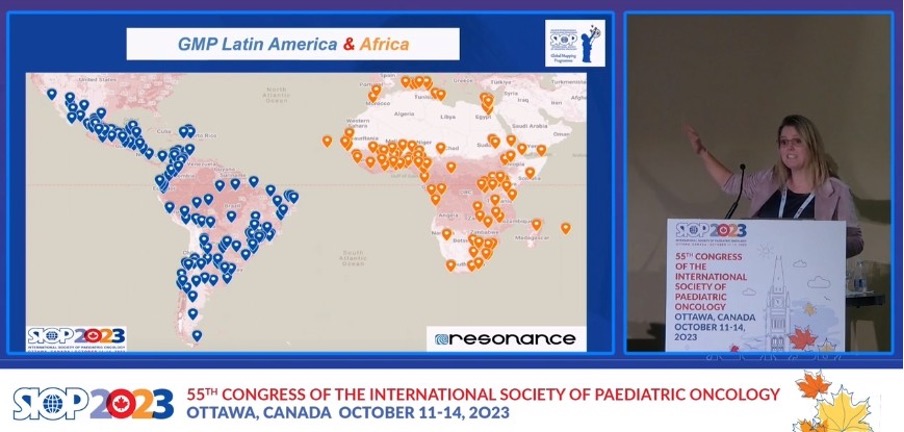
Every facility treating children with cancer in the whole wide world
I have been involved in this since 2018. We are creating a database of all facilities treating children with cancer across the world. Yes that’s right, every facility in every country. This is to help parents, provide data for national societies to advocate for more resources, and enable collaboration. We recently reached a big milestone with Latin America and Africa mapped This is Maite Gorostegui, a paediatric oncologist from Barcelona, and chair (and President) of the SIOP Global Mapping Team giving an update and showing this wonderful map that will shortly be published.
Not so long ago I came across the word “abandonment”. I didn’t know what it meant. This is the term for when treatment for cancer is not completed.
It is a huge problem and is the main cause (approximately 40%) of treatment failure in low income countries. This happens for a variety of reasons including families living in difficult conditions, families not having their basic needs covered, parents can´t afford to get to the hospital or the extra costs associated with caring for a child with cancer. What CANCaRe Africa – Zero Abandonment from Start to Finish does is provide small amounts of money to families with cancer. This can be for food when one parent is staying at hospital, or travel costs. This is carefully documented, and the data is showing it is working: families are finishing treatment. CANCaRe Africa is a project that is in action in 10 centres in 7 countries across Africa. Over the years I have been involved with many projects and groups. This one is close to my heart as I can see the data, and I can see rates of abandonment reducing, meaning lives are being saved.
Virtual training
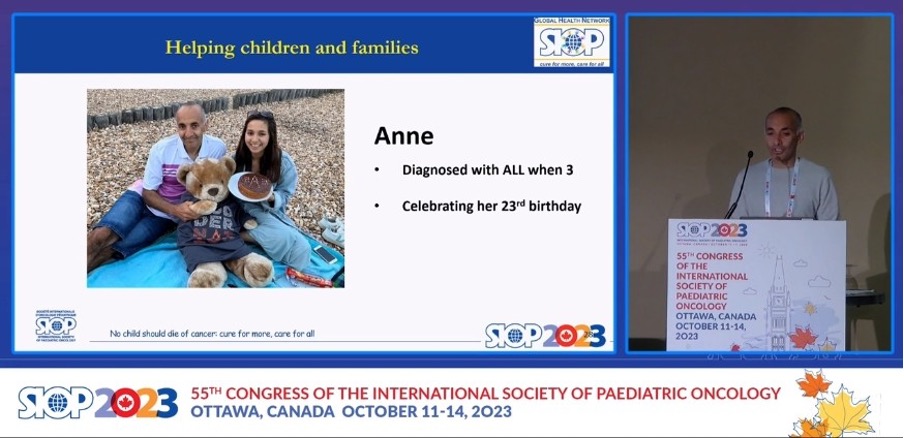
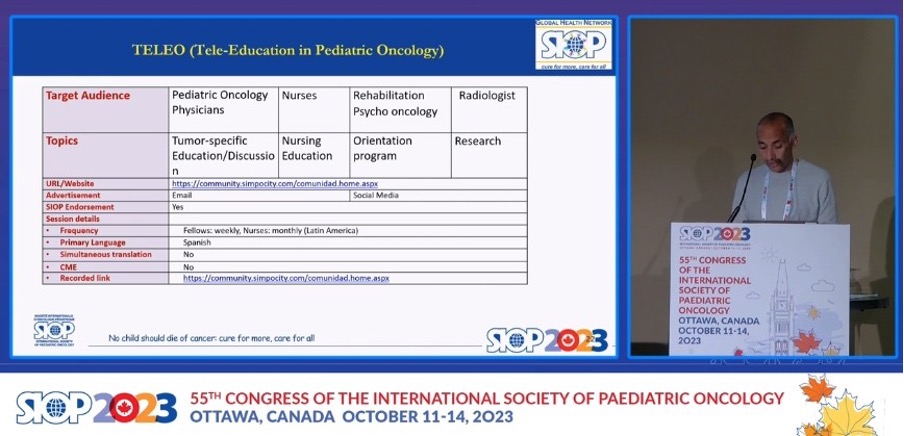
We know that a lot of clinicians around the world treating children with cancer don’t have the necessary or best training. They are doing the best for children with very limited resources. They can’t afford to attend conferences or in-person training courses. We identified some of the key organisations and partners of SIOP that produce online training. This is me presenting the data at SIOP and listing some (definitely not all) of the organisations. See the end of this article for links to the organisations mentioned in the presentation. When we were discussing what to present, I didn’t think this was a very good idea. In fact, I was adamant it was a bad idea. I was completely wrong. The session was successful and well attended, and we had a very interesting discussion afterwards. Thank you Muhammad Saghir Khan for having the vision to push this forward.
TELEO leading the way in providing online educational materials
Too Many Nos
One afternoon whilst in Ottawa we came across a problem. I couldn’t see a way around it. I was with Dr Matie Gorostegui who was coming up with a lot of ideas and suggestions. I was finding fault with all of them. She looked at me and said flatly, “Too many nos.” At first I was taken aback. Now, after much consideration, I realise that I need to be more aware of my behaviour. I often have ideas and suggestions, and I hope that others are receptive to them. Do I do the same for others? I am not saying that I must say yes to everything, but I do need to be more open to ideas and change.
Genuine inspiration
I am not a clinician. I am employed by the LSEG (London Stock Exchange Group) to help its clients buy and sell foreign exchange. In fact, it is interesting using my experience from being employed at a large multi-national to suggest things to the SIOP secretariat. That having been said, in my day job I am not involved in research, I am not treating children with cancer, or looking after their families. The majority of the paediatric oncologists and oncology nurses I meet are doing research as well as their day job. Often in their spare time, participating in or running meetings in the evenings and weekends, and attending conferences away from their families. These people don’t just work from 9am to 5pm. Especially when you consider where this research is being done, often by clinicians with an extraordinary workload, with staff shortages, poor supply of chemotherapy, power cuts etc. The research may or may not help their career, but it is definitely helping children with cancer. Thank you to all of you. And thank you for inspiring me and so many others with your dedication.
Breaking down barriers
SIOP comprises clinicians, researchers and a few parents. The last congress had 3,300+ healthcare professionals attending from 110 countries. They say that sport can be used to break down barriers. That may be true, but the medical community is a much better example. I have seen first-hand many collaborations between the global north and global south, research projects and clinical trials spanning continents including conflict zones, research teams with people from different continents. I haven’t done anything with Medicin sans Frontiers personally, but I have a lot of respect for what they do. Their ethos and name applies to the paediatric oncology community.
Decisions, decisions
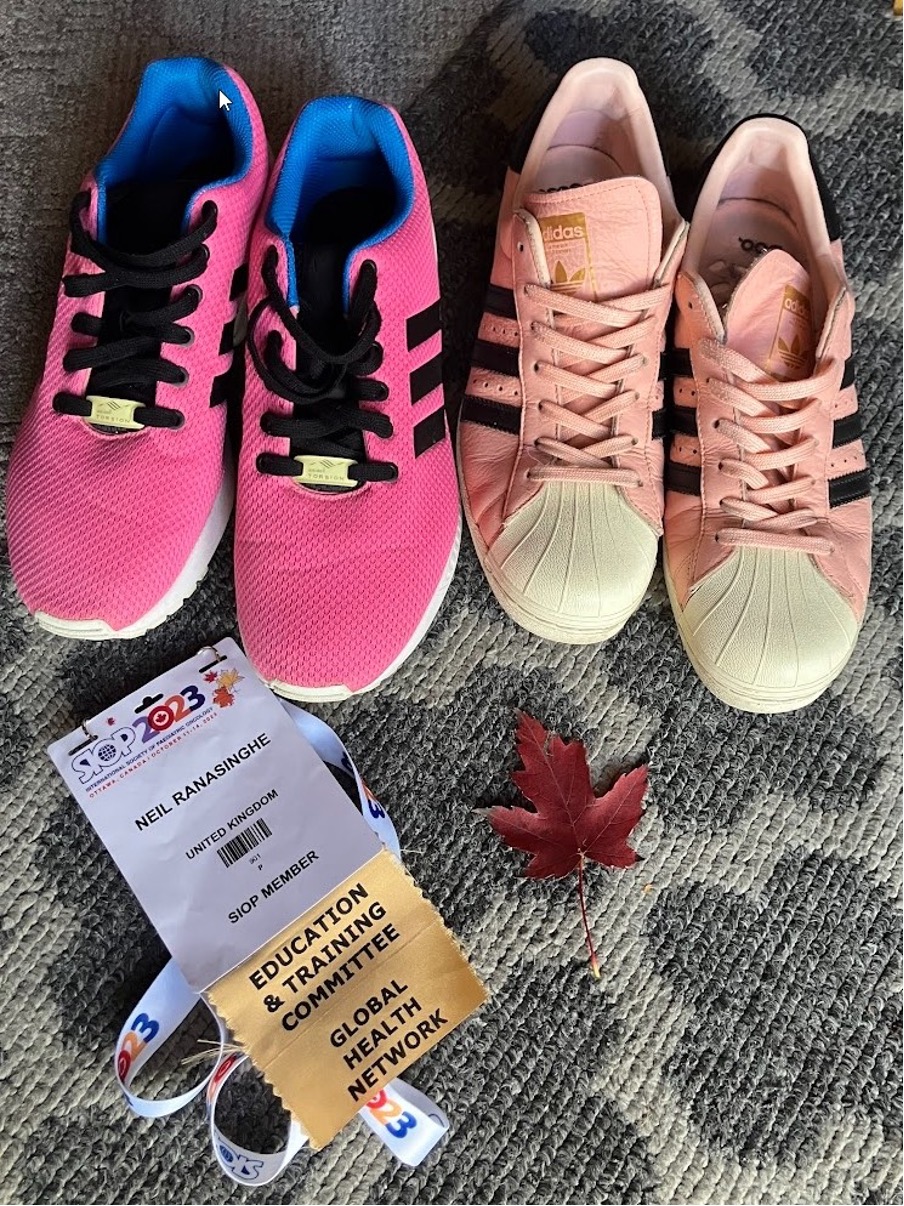
I can’t write an account of Ottawa without mentioning my pink Adidas. This was the second decision of the day. Which trainers do I wear? Not an easy one is it? I had already made the first and another important decision, where do I run?
Pink or pink? Pink for breast cancer awareness month, and see the real red maple leaf.
It is because I am a Canadian ♫
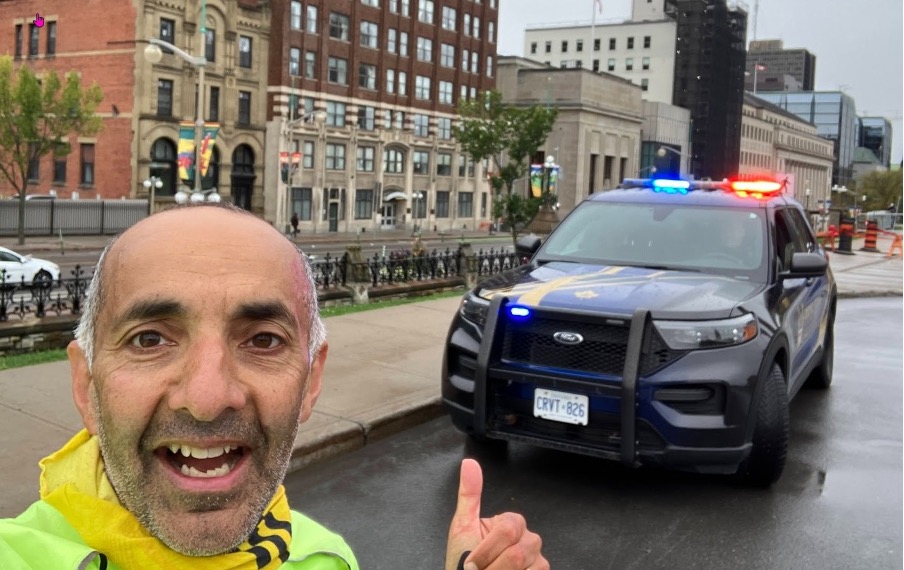
Finally a massive thank you to the people of Ottawa. Without exception, everyone I interacted with was either friendly and helpful or very friendly and very helpful. I chatted to an officer of the Parliamentary Protective Service and asked for a selfie, and he put the flashing lights on for me.
Stopped for speeding whilst out running…
I commented to a woman at the cloakroom in the Centre Shaw Centre that it was great seeing them all as they were always so cheerful, and she sang her reply to me. “It is because I am Canadian”.
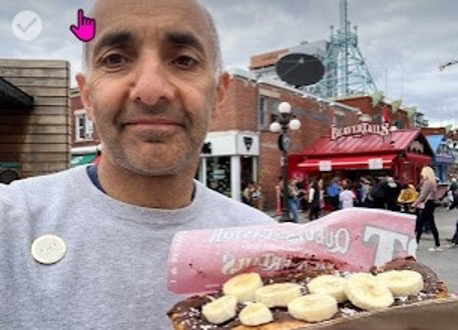
Of course I had to try the local food, and in particular beavertails, a delicious cross between doughnut and pizza.
Definitely not a real beaver’s tail
Please get in touch
If you want to know more about any of the projects I have mentioned, or you have any suggestions or comments, please don’t hesitate to contact me. Neil.Ranasinghe@lseg.com. I need to sign off here as I have a very long list of actions from attending SIOP.
Organisations providing paediatric oncology online virtual training
Organisation
URL
Groupe Franco Africain d’Oncologie Pédiatrique (GFAOP)
Meetings The 2025 Autumn Conference season is now upon us. The following meetings may include sessions that will be of interest to Network Members. 17-21 October ESMO Congress 2025 (Berlin, Germany) Register:...
Keep Calm and Stay Strong Nearly three out of four deaths worldwide are caused by four noncommunicable diseases (NCDs): cardiovascular disease, cancer, chronic respiratory disease, and diabetes.1 The Political Declaration on the Prevention and Control of NCDs and the...
A stellar cast speaks at the House of Commons Tickets are now available for the London Global Cancer Week Final day event “Cancer Health Disparities: Understanding the inequalities conundrum” on Friday 15th November 2024. The venue will be the House of Commons Terrace...
Update of the UKIGCN website The UKIGCN has undergone an overdue spring clean courtesy of Simon Middleton. The function of our website is primarily to be the Network’s presence on the internet and to provide a ‘shop window’ by which visitors can find out about the...
The last slide of my presentation - thanking everyone that provides online training - enabling children with cancer to grow up and have birthdays I would like to share three things with you today: My account of the International Society of Paediatric Oncology -...
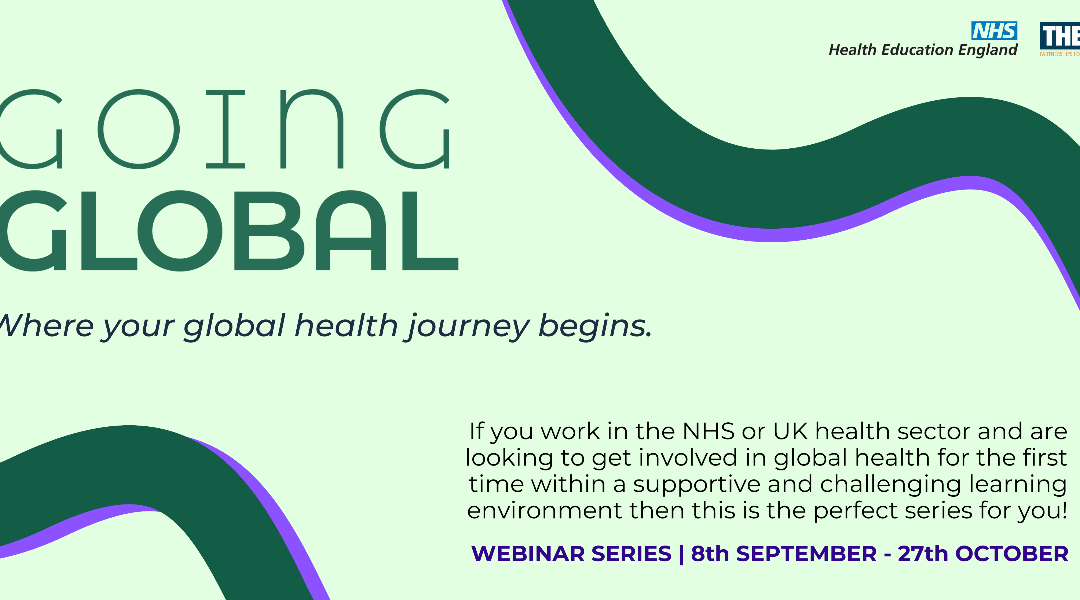
In partnership with Health Education England, we are hosting a series of eight webinars. Free to attend, this series will provide you with the key things you need to know before beginning or furthering your global health journey.
The series at a glance…
Taking place every Wednesday between 8th September – 27th October, the series offers an unparalleled opportunity to learn from and engage with experienced colleagues in the field through a mixture of workshops, presentations and interactive sessions.
The series is designed for NHS staff and final year medical and pharmacy students. From exploring the different opportunities available, to understanding how you can capture the learning you gain whilst volunteering overseas or virtually, the series is a fantastic place to find out more about getting involved in global health.
Register on the NHS Going Global website for more information.
The recent announcement of the cancellation of the UK Partnerships for Health Systems (UK PHS) programme will cause widespread distress. The UK Partnerships for Health Systems programme has helped many low- and middle-income countries build stronger and more resilient...
The UK Global Cancer Network (UKGCN) was launched on November 15th 2020 as part of London Global Cancer Week. The launch was a virtual meeting co-chaired by Professor Richard Cowan ( Consultant in Clinical Oncology and...
This week, global leaders, international organizations, scientists, business representatives and civil society are gathering in Antalya, Türkiye, for the 31st United Nations Climate Change Conference (COP31).
The recent announcement of the cancellation of the UK Partnerships for Health Systems (UK PHS) programme will cause widespread distress. The UK Partnerships for Health Systems programme has helped many low- and middle-income countries build stronger and more resilient health systems and to make progress towards universal health coverage. By the FCDO’s own admission, the Programme has performed highly in difficult circumstances given the COVID-19 pandemic. It may be the purest example of the UK’s ‘soft power’.
The FCDO has produced no credible evidence that the UK’s decision to reduce its foreign aid contribution is in line with taxpayers’ preferences. On the contrary, if the SARS-Cov-2 pandemic has taught us anything it is that the Health is global and that health system failures stemming from the lack of resources and professional training, or poor health surveillance in one country can affect the health of us all. Severing these links between the UK and low- and middle-income countries will result in thousands of lives lost overseas (many of them in Commonwealth countries) that otherwise could have been saved and will further undermine the UK’s global reputation as a country that keeps its word.
The UKGCN is discussing ways that we can publicly petition the FCDO to reverse this decision. Much can be achieved if we act both individually and collectively, and in concert with other concerned bodies. We would welcome the views of colleagues, please share your thoughts with us as to how we can oppose this retrograde step and continue our vital partnerships with colleagues in low- and middle-income countries.
The UK Global Cancer Network (UKGCN) was launched on November 15th 2020 as part of London Global Cancer Week.
The launch was a virtual meeting co-chaired by Professor Richard Cowan ( Consultant in Clinical Oncology and Director of The Christie School of Oncology , The Christie NHS Foundation Trust Manchester) and Dr Susannah Stanway (Consultant Medical Oncology, Breast Unit, Royal Marsden NHS Foundation Trust, Surrey).
The mission of the UKGCN is to enhance the UK’s contribution to cancer care in LMICs by bringing together the talent, resources and enthusiasm of individuals and organisations within the UK in a more strategic and collaborative body, with the intention of improving the outcome and experience of people affected by cancer in low and middle income countries.
The first project for UKGCN will be to conduct a comprehensive and systematic mapping exercise of the existing and planned links and partnerships involving UK colleagues and colleagues in low and middle income countries in the field of cancer care.
Written by Mark Lodge, UKGCN Steering Group Member